

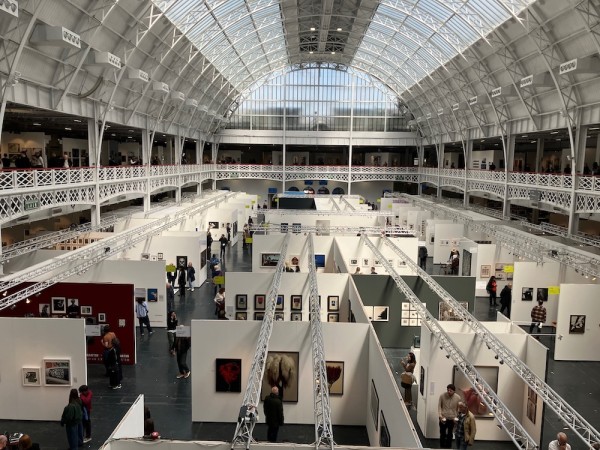
Photo London, interior view.
It finally happened. For its 11th edition, May 13-17, Photo London moved from Somerset House to the National Hall at Olympia. It was about time. Somerset House was, despite its charm, a more than awkward venue for a major photography fair. The temporary pavilion in the courtyard had a lot of traffic, the East and West wings less so. The first floor was often a desert and many visitors simply gave the rooms on the various levels below ground a miss.
This time Photo London looked like a proper fair. The building is currently undergoing refurbishment, carried out by Thomas Heatherwick, one of the world's leading architects, and despite the hall still looking a bit worn here and there, it worked just fine. The main exhibitors were on the ground level while the Discovery section, Positions (a platform for artists with representation), the exhibition of Master of Photography 2026, Steven Meisel, and book publishers were on the first floor (for Americans the first floor in Europe is the second floor in North America).
The grid structure of the layout also meant a leveling of the playing field as far as costs for the exhibitors were concerned. One of them, who asked for anonymity, told me that he had paid much less for his stand at Olympia than he had for a much smaller space in the pavilion at Somerset House.
Candlestar, the promoter of the fair, had evidently spared no effort in getting some very good galleries to sign up and there were many excellent presentations at the fair. Still, there were more than a few that left me indifferent. I thought the choice of Steven Meisel as Master of Photography was strange to say the least, and I was not alone in wondering, "Why?"
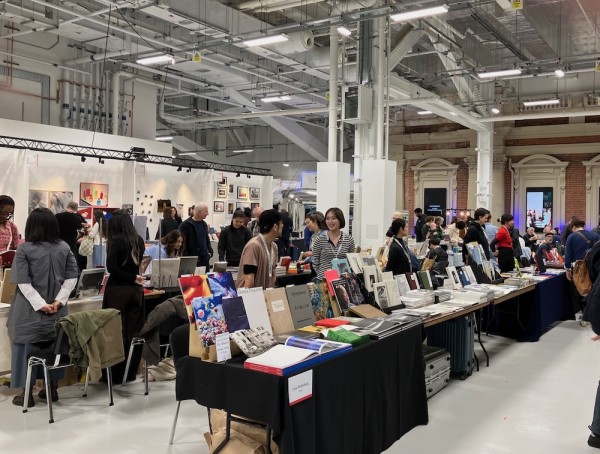
The photobook section was strong at Photo London.
The book publisher section, however, was simply wonderful. The best I have experienced at any fair. At other fairs, they're usually crammed together but here there was ample space between exhibitors. But the move to Olympia comes at a time that's particularly hard for the photography market. And there was still the major issue for Photo London that the UK has never had a strong local photography collector base.
Goodman Gallery, London, Cape Town, Johannesburg, New York, in collaboration with Prix Pictet, showed Alfredo Jar's monumental "Searching for Africa in Life Magazine".
Jo Stella-Sawicka told me: "Alfredo Jar won this year's Prix Pictet, and we were invited to present a major work of his here at Photo London. It's a series of light boxes showing all 2,128 covers of Life magazine in its 60-year circulation, from 1936 to 1996. The project came out of a period of research after Alfredo had been in Rwanda following the genocide. As a visual artist, he has been long interested in the media, thinking about a critique of it with regards to what it does and doesn't cover. He came back from Rwanda and realized that the media had a huge blind spot when it came to Africa. Life magazine invented the discipline of photo journalism. It sent photographers out into the world to bring back the news. In this enormous body of work, there are only four covers dedicated to the continent, and in those cases what we see are stereotypes; wildlife, starvation, troops, a third-world continent. Nothing to do with apartheid or the great African statesmen. It was a very specific worldview that informed people in North America."
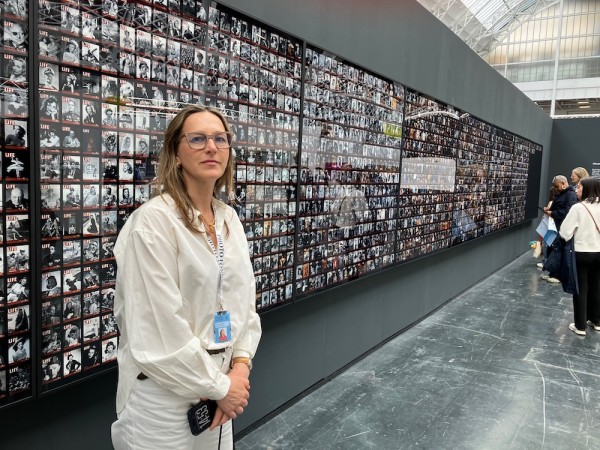
Jo Stella-Sawicka, Goodman Gallery.
The work was for sale. "We haven't sold it here at the fair, but Photo London gives us an opportunity to have conversations with museums and leading collectors. A project of this scale would take a long time for a museum to find funding for so this is very much the beginning of a process, making it visible and raising awareness and hopefully building towards a successful outcome."
Further down, Polka, Paris, had taken a large booth to present a solo show with Joel Meyerowitz. Inès Grégoire told me: "We decided to show Joel Meyerowitz for several reasons. It's a big year for him. He won the Sony World Photography Award and was given the ICP Lifetime Achievement Award; plus, he lives in London now, so it was in the cards. He produced all the prints here in London. The idea was to give an overview of his achievements, starting with black and white work from 1962 and leading to the large color work of Cape Cod and landscapes."
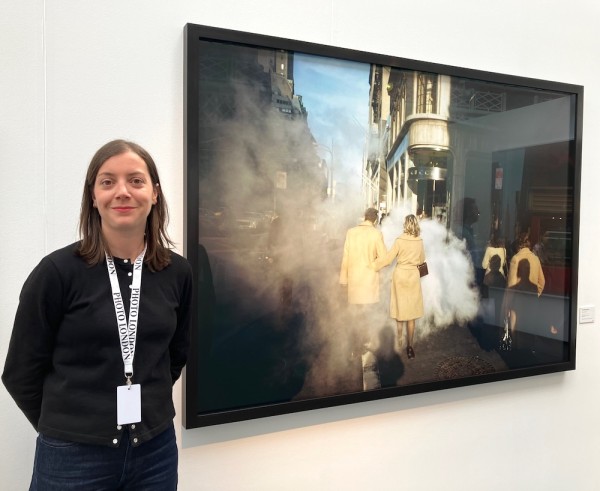
Inès Grégoire, Polka.
The exhibition had been well received. "Joel is almost a superstar here in London so we haven't had to explain it to people. We have exhibited as a gallery at Photo London before, six years ago but we also participated last year as part of Prix Pictet, with Sebastião Salgado, and then he sadly passed away about a month after the fair."
Grégoire was pleased with the sales that the gallery had achieved. "The smaller works start at 9000 pounds, and we have sold five of those, which means we have covered our costs."
The solo presentations formed a path through the fair and were curated by Tristan Lund, who was given full marks by the exhibitors. Also on the path was Jednostka Gallery, Warsaw, which showed works by Polish artist Weronika Gęsicka. She uses found images to explore gender roles, consumerism, history and social memory, using Photoshop and AI. It's a crowded field but she takes it to a whole different level.
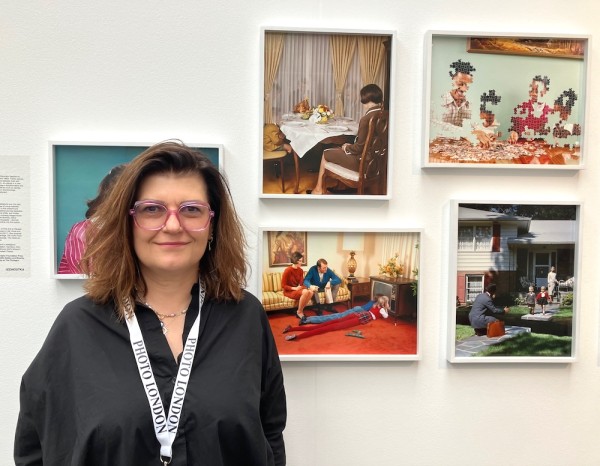
Katarzyna Sagatowska, Jednostka Gallery.
Katarzyna Sagatowska told me, "Weronika Gęsicka is shortlisted for the Deutsche Börse Photography Prize, 2026 and her work is exhibited at the Photographers' Gallery in London, so it was logical to bring her works here, not only Encyclopedia, which is shortlisted, but also works from Traces and Cliffhanger series, to present her work in depth."
Reception had been great. "Many visitors know the work from before, from exhibitions, books and magazines. From a visual point of view, the works are very accessible. They seem funny at first but when you look closer, you see the darkness and the other levels. I see it in the faces of the visitors as well, how their smiles just freeze up when they realize that the work is not so fun and sweet."
Sales had been good, Sagatowska told me. "We have sold works to British collectors, to American collectors, and we are discussion with others about sales as well. In addition, we brought a huge pile of books, all sold, so we are really happy."
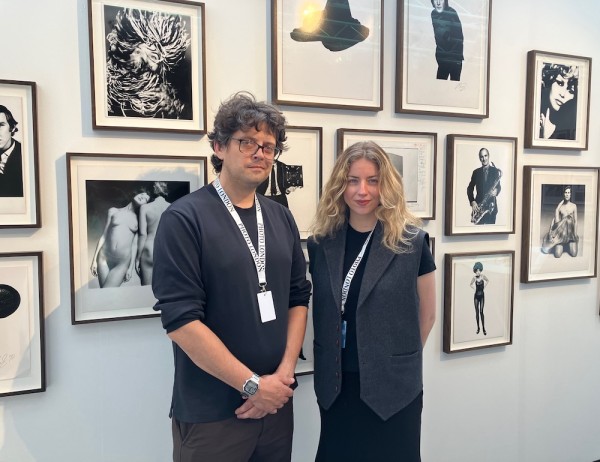
Fenton Bailey, David Bailey’s son, and Malak Kabbani, Camera Eye Ltd.
Close by, Camera Eye Ltd., London, did a solo show of vintage prints by David Bailey. These were real rarities. Many years ago, photographer John Swannell told me that back in the day when he worked as Bailey's assistant, he had been ordered by him to throw out most of the prints, about which he enjoyed reminding Bailey. Bailey was one of several photographers who made a name for himself in Swinging London, but he was always a cut above the rest. Others often got caught up in the trappings of the time, clothes, hairstyles, etc. but Bailey always created a strong sense of connection with the people he photographed, whether he shot fashion or portraits, giving his images a timeless quality. The images here were almost a who's who of the 60s and early 70s, Jean Shrimpton, David Hemmings, Brian Duffy, Helmut Berger and many others.
Malak Kabbani told me, "As a gallery, we're an extension of Bailey's studio. Photo London offers us an opportunity to connect with collectors and dealers, and that's an important aspect because we will increase our public profile in the coming years, hosting film screenings, presenting talks and exhibitions, so it's nice to be able to let people know en masse in a place like this. We like the new location. It feels more like a proper fair and with two floors, it's a lot more manageable than Somerset House. Reception to the presentation has been amazing, especially because they're vintage prints. I think we're attracting a lot more people who are looking for authenticity, who are looking for something that isn't so perfect, something that they know has been handled by the artist, that has that direct link to the artist. Sales have been good and we have a lot of collectors coming back today; and it seems to be the case with Photo London that there's usually a fair amount of business after the fair."
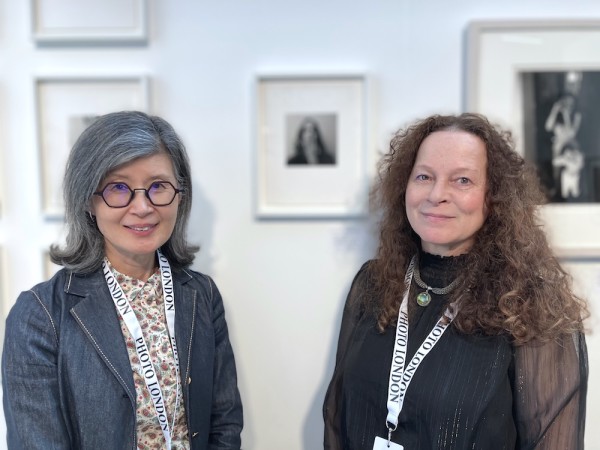
Miyako Yoshinaga and Kristina Shook.
This was the first time Miyako Yoshinaga, New York, showed at the fair. She told me, "Initially, I thought about applying for the Source section, which would have meant focusing on a single artist, but, as this is my first time at the fair, I decided to do a wider presentation to give visitors an insight into my gallery. I decided to show three black and white analog photography artists, Melissa Shook, Mikiko Hara and Hitoshi Fugo, each of a different generation and with their own unique language and sensibility, which creates a very interesting conversation."
Melissa Shook's daughter, Kristina Shook, attended the fair, and a film she has made; "Your Eyes and Love in Grain Sand", was screened elsewhere at the fair.
Yoshinaga continued, "People see Melissa Shook as a pioneering female artist, digging into the mother-child relationship, and the work is also about her identity as an artist and female single mother. A lot of people relate to her work, especially women, and Kristina and I are very happy that we're able to present her first documentary film about her mother's work from the perspective of her daughter. It's a very emotional film and the response has been great."
You can see the film here:
https://next.frame.io/share/c4364ce5-3b3e-4606-bbe4-bb8ca9f01d53/view/c5a3224e-c91b-4f02-bed4-4986d36c5b97.
Sales, however, had been slow. Yoshinaga told me, "I hope that they will happen in the last few hours today, or that there will be some after-sales. I understand that a lot of people see us as first timers and that we have to be patient. Importing and exporting to the UK presents various problems, and next time we will have a better pricing strategy as well."
I was deeply saddened when news reached me earlier this year that veteran dealer Robert Hershkowitz had passed away. His wife Paula and daughter Kate have decided to carry on with Robert Hershkowitz Ltd., and their stand at Photo London was simply magnificent. For protection against the harsh light, a special ceiling of white fabric had been installed.
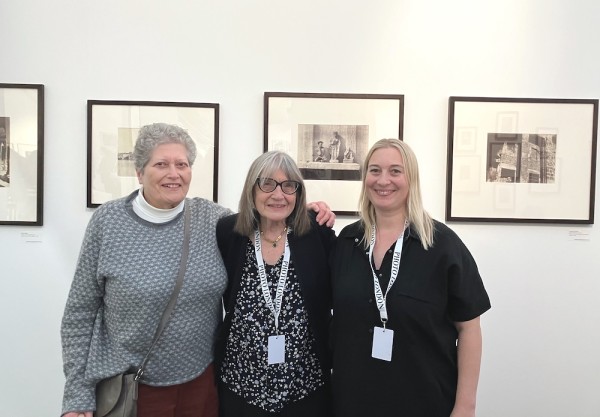
Daniella Dangoor, Paula Hershkowitz, Kate Hershkowitz.
Kate Hershkowitz told me, "We wanted to have a stand that reflected our late dear husband and father, and so we have included some of his favorite photographs of all time: The Dijon farmyard scene, the Thomas Elmore of the Moors of Algiers, Captain Linnaeus Tripe of Burma, photographs by Roger Fenton, Gustave Le Gray, Roger Fenton, Julia Margaret Cameron and many others. We have blended those masterpieces with photographs that are more affordable.
"Our stand is quite different from the others here at the fair. A lot of people have been surprised by the fact that these are original photographs, and that they have lasted this long. We had so many people asking questions that we wrote a sign explain this. We have had quite a few students coming in, and it's nice to speak to them about the processes from the 19th century."
I visited the stand several times. On one occasion, I was quite surprised to see the Dijon farmyard scene under the arm of a visitor walking away. I'm sworn to secrecy but I suspect it was the most expensive work sold at the fair. Robert often showed it at fairs and it was the cover image of his book "About Sixty French Calotypes".
Kate Hershkowitz told me, "Even though he was buying to sell, he'd always buy things that he loved, that meant something to him or spoke to him. He never got tired of looking at the Dijon but I think he would have been proud that we had sold it, and that it goes on to have a new life with somebody else. But we have sold many other photographs besides the Dijon, a Fredrick Fiebig of Colombo and several P. H. Emerson photographs from "Marsh Leaves" so we're very pleased with the results."
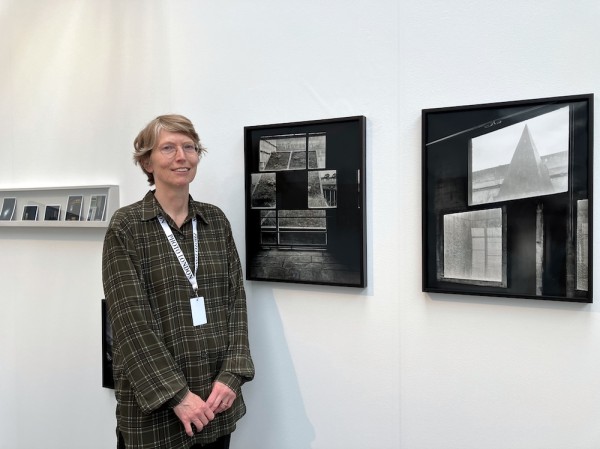
Charlotte Schepke at Large Glass.
Large Glass, London, presented a solo show with Swiss-French architectural photographer Hélène Binet, and it was breathtaking. Binet has worked closely with leading architects such as Daniel Libeskind, Zaha Hadid and Peter Zumthor over the years. While well known in the world of architecture, she is less known in the photography world, making this presentation all the more welcome. Charlotte Schepke told me, "It felt it was right to show Hélène Binet at this year's edition of Photo London. She's London-based and she had a big retrospective exhibition at the Royal Academy a few years back. Also, I feel her work is very expressive and very self-explanatory. There's lots to take in.
"It's also nice to have some sort of clarity, a sort of stillness as well. I feel in her work is very much about pausing and observing. Of course, it's very much about time, as she's working in photography, but in her case, time and making observations. The prints are handmade, simply beautiful and architecture is something that Londoners are very well versed in so it felt like the right choice."
Reception to the presentation had been very good. "We had fantastic feedback and reception, not just to the works but also to the hang. Quite a few people have discovered her work here too, which is, of course, always what you hope for as well. Lots of people have recognized it, but what we've achieved here is to bring her more into a photographic context rather than architecture. Sales, however, have been slow. With fairs, you often have to think long-term. I think we've made a lot of good new contacts, had a lot of sales inquiries; and hopefully that will manifest in sales in the coming weeks, but it has been slow."
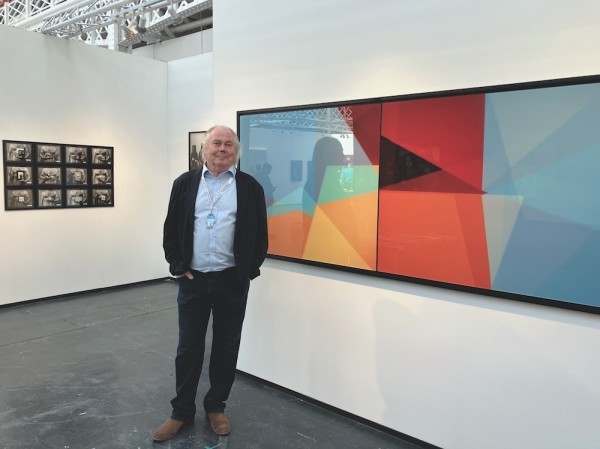
Timothy Persons, Persons Projects.
It had been slower than slow for Persons Projects, Belin. The gallery showed works by several artists; Niko Luama, Grey Crawford, Jorma Puranen and others. The gallery has done well in previous years, not so this time. Timothy Persons told me, "With the move to a new venue, there was a question mark hanging over this year's edition because we didn't know who the clientele was going to be, so we tried to design it around works from the 60s, works from Eastern Europe that are notable, and a whole section of new, unique pieces. Sales have been absolutely horrible. We have only sold one small-size piece. Many exhibitors here have not sold a single thing. There simply aren't clients to sell to here.
"At Paris Photo, we sell tons every time. What has saved me this time, at least partly, is that we are in London; so last night, I took some portfolios that I managed to sell to friends, but that was outside the fair. That's not sustainable. For most exhibitors here, the cost is the same as doing Paris Photo but Photo London is not providing us with collectors and buyers. In the photography market, there's a shift in the collection tradition. The old collectors that sustained the engine are not buying anymore. What everybody has to do is to focus on educating the next generation of collectors, people between 30 and 45, and we're not talking about buying pieces to hang above couches for decoration. For contemporary works, it's about engaging collectors from the art world. My advice to Photo London would be to hire a top PR firm that really understands the art world. As for this year, it would be great to get some after-sales, but I'm not optimistic. I really don't know if I'm going to do this fair next year."
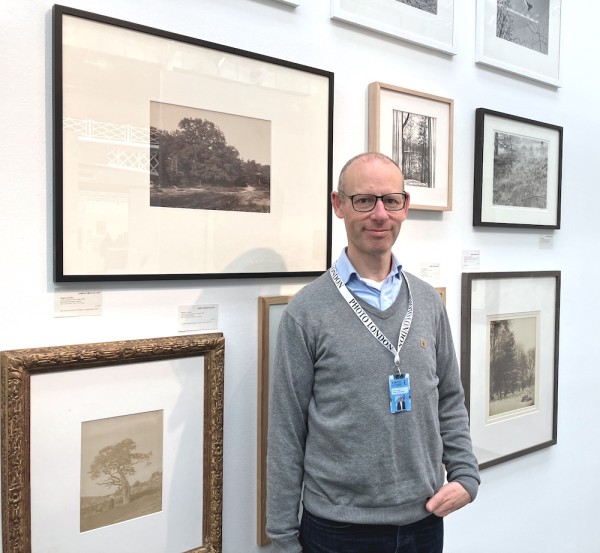
James Hyman.
James Hyman Gallery, London, had achieved better results. Hyman told me, "What we've tried to do, as this fair is so well known for contemporary photography, is to give a bit of an overview of the first 150 years of photography. On our long wall we featured pictures of trees, including an important André Kertész and an 1849 picture by Gustave Le Gray, which might be the first photograph that was taken of a painter working en plein air. The wall next to it is about women, including a major Bill Brandt that was deaccessioned by MoMA. There's a Lady Clementina Hawarden and lifetime prints by Vivian Meyer, so there are a few highlights to excite people. On another wall we have pictures of artists and studios, including a very rare John Deakin of Pavel Tchelitchew in Rome and Leigh Bowery in Lucian Freud's studio by Bruce Bernard. On the outside, we have three mini presentations of Linda McCartney, vintage Henri Cartier-Bresson and Edward Steichen."
Hyman reported good sales. "The move to Olympia has been very good for the fair and it has a good energy. The works that were most popular were two very rare pictures by the French writer Emil Zola. For a brief period, he also took photographs, mainly of his immediate circle. We had a very beautiful cyanotype that he made of flowers, which we could have sold many times over. But we've sold all sorts of other things, including works by Cartier-Bresson, Vivian Meyer, so we've been pleased with how it's gone. The 19th-century material is always a harder sell at Photo London, but I feel it's very important to show it and excite people."
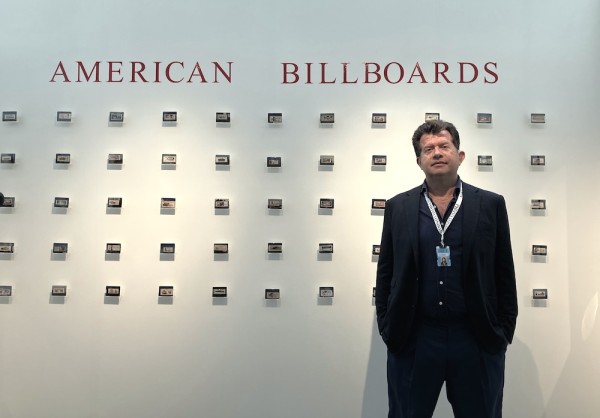
Roland Belgrave.
Roland Belgrave, Brighton, signed up just two weeks before the fair, but true to form he put on a great presentation; platinum prints by Jan C. Schlegel, American barns by Blair Getz Mezibov and tiny photographs of American billboards from around 1950. Belgrave told me, "I did well with Jan C. Schlegel. I met Blair Getz Mezibov in New York. He's best known as a fashion photographer. People liked the American barns, but sadly there were no takers. Installing the tiny billboard photographs was a nightmare. In the end, I sold just a few. Still, I covered my costs and being here was a good promotion opportunity."
Belgrave and I were both very impressed with the solo show with Jane Evelyn Atwood, presented b L. Parker Stephenson, who had teamed up with In Camera Galerie, Paris.
L. Parker Stephenson told me, "There were many reasons why we chose to exhibit this work. One was related to Jane Evelyn Atwood being shortlisted for the 2026 Deutsche Börse Photography Foundation Prize for her 2025 book Too Much Time: Women in Prison (published by le bec en l'air). In conjunction with this, The Photographers Gallery in London was presenting an exhibition of this work (March 6 - June 6th) so the audience would be immediately familiar with her work or have a chance to visit TPG and see a more in-depth presentation of the series (than what we were showing). DB announced the prize mid-way at a big event at TPG mid-way through the fair. While Atwood was not ultimately chosen, a large portion of the audience supported her serious, in depth, long-term, committed work about a group that was and continues to be easily and often overlooked.
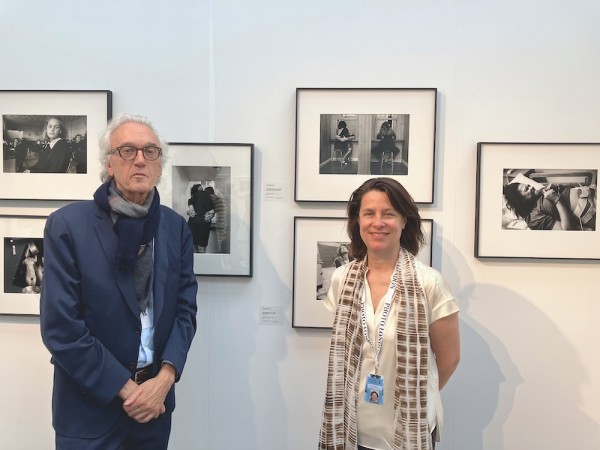
Jean Noël de Soye, In Camera Galerie, and L. Parker Stephenson, New York.
"Second, was the encouragement we received from those involved in Photo London itself. The curator of the Source section, Tristan Lund; the co-founder of the fair, Michael Benson; and Photo London Director, Sophie Parker were all keen to have us participate with Jane Evelyn Atwood's work. Related to this was the presentation of a solo booth of Atwood's 50-year (and still going) career. This was invaluable in showing people the depth of her work, her consistent eye, and her commitment to those in closed communities.
"And finally, the third reason, was that Atwood's Parisian gallery, In Camera and I (who represents Atwood in the US) could co-present Atwood in a single booth. This meant sharing costs and contacts, and work load and energy to present an artist who we have both supported and known for many years. It's always a risk to present a solo booth and participate in a fair but here, the stars really aligned."
Response to the presentation had been overwhelming. "Many who considered themselves knowledgeable about photographers were elated at their discovery of her work, those who have known her work were thrilled to see its recognition. And were enthralled by the work. We were pleased by the sales to both existing and new clients."
The main focus of England & Co, London, is on conceptual and performance-related photography. The gallery showed an impressive selection of works by Anne Bean, Sue Barnes, Liz Rideal, Li Yuan Chia, James Collins, Vlatka Horvat, and others, as well as works by Bill Brandt and Man Ray. I was particularly drawn to recent works by Anne Bean, from "Frank Series", based on photographs she had taken at the exhibition "Frank Auerbach. The Charcoal Heads" at the Courtauld Institute in 2024. For me, these were among the top works at the fair.
Jane England told me, "Anne Bean watched other people in those exhibition small rooms and observed that people seemed to be attracted to pictures that somehow resonated with them, that they were becoming imbued with the actual subjects of Auerbach's deeply felt, long considered portraits that he worked on for years. She felt she was in almost an immersive performance, and started very discreetly taking photographs, and the viewers just assumed she was photographing the pictures, but she was actually as interested in them as the actual pictures on the wall. Later on, she printed them and worked on them with paint, giving them this rather extraordinary quality. Reworking photographs is not a new method for her. She started doing in the 1970s."
It was an impressive stand. Sales had been less so, "Though we did sell a few works.", England told me.
Tom Gitterman Gallery, New York, had teamed up with UK-based Stewart & Skeels for a solo show with photographs by Roger Mayne. They had a great spot, to the right of the entrance. These were some of the best of Roger Mayne's images and the prints were perfect. While Stewart & Skeels exhibited for several years at Photo London, it was a new experience for Gitterman, who told me, "I hadn't really had the impetus to participate at the Photo London before, but then news came that the fair was moving to Olympia. Tristan Lund, the curator of the Source section contacted me and suggested doing a solo booth with the work of Roger Mayne. I instantly thought of Lindsey Stewart and Joanna Skeels as partners in this, since they co-represent the estate, and so we decided to split the booth. The inventory comes from the gallery, so I framed it all and shipped it from New York."
Gitterman described the response as simply phenomenal: "It's very rewarding that people who don't know Roger Mayne's work can see the quality of it. Many people have come back again and again and said "This is our favorite booth in the whole fair." That does not normally happen, and it's lovely to hear. We were flattered that they put us up front, but I think it was also part of their strategy to have an older British artist that is in major institutions in England to be represented in the front of the fair and to show that the fair has academic excellence to the fair. It's good to be a part of that, and to be able to give back to the greater community as much as we can. We have met a bunch of people that we did not know before. Though they may have not bought, they are definitely potential clients for the future. I've never done a public venture in London, and I've always wanted to. My mom's British, most of my family's over here, so it's a treat to be able to be in London, and to be able to do business, and to be able to present an artist that I have been working with for decades. My first show as a gallerist was in 2004 and it was with Roger's work. Lindsey and I both were very fond of Roger and close with him, and now represent his family so it's meaningful to us on multiple levels. We have had several sales as well, which always helps."
Stewart & Skeels used to exhibit in the West Wing at Somerset House, alongside most of the vintage photography dealers. Stewart told me, "I think the West Wing was a fairly unique venue in itself within part of the whole Somerset House complex. Really, we loved the room that we had there. It suited us, especially when we were showing British photography, mostly from like the earliest days up to and including someone like Roger Mayne, so that we could show the linkage between the different eras and different work and different processes and things like that. It's completely different being here. The venue is just amazing and our space actually works really well. I think the contribution that Tristan Lund has made with the Source section has been really effective, giving some sort of trail through the fair of stands that is really exciting."
To the left of the entrance, Galerie Julian Sander, Cologne, was honoring Rosalind Fox Solomon with a stunning solo presentation; an elegant display of both well-known and lesser-known photographs. The 1977 portrait of William Eggleston was one of the standout photographs at the fair. Julian Sander told me about his impressions of the change of venue.
"There were some light ruffles at the edges, things like drinks availability on the opening night but they were minor things that a new location brings with it. I think they did a great job. Attendance was good and it wasn't overcrowded like Paris Photo. What was lacking was institutional buyers and serious private buyers. I can't sell pictures to people who are not there. The next job they need to do is now that they've found a successful form for the fair is to get those people to attend."
As for sales, Sander told me, "We did well, though not as well as I had hoped, for the reasons I mentioned. It's my impression that, traditionally, the successful price point at Photo London has been 2000 to 3000 euros and these works start at 7500 euros. They have proved that they can put on a great looking fair. What they need to do now is get more good galleries to exhibit. That way buyers will come automatically."
Michael Diemar is editor-in-chief of The Classic, a print and digital magazine about classic photography. In August 2025, he cofounded Vintage Photo Fairs Europe, an organization focused on promoting independent tabletop fairs in Europe and spreading knowledge about classic photography in general. He is a long-time writer about the photography scene, writing extensively for several Scandinavian photography publications, as well as for the E-Photo Newsletter and I Photo Central.


Share This