

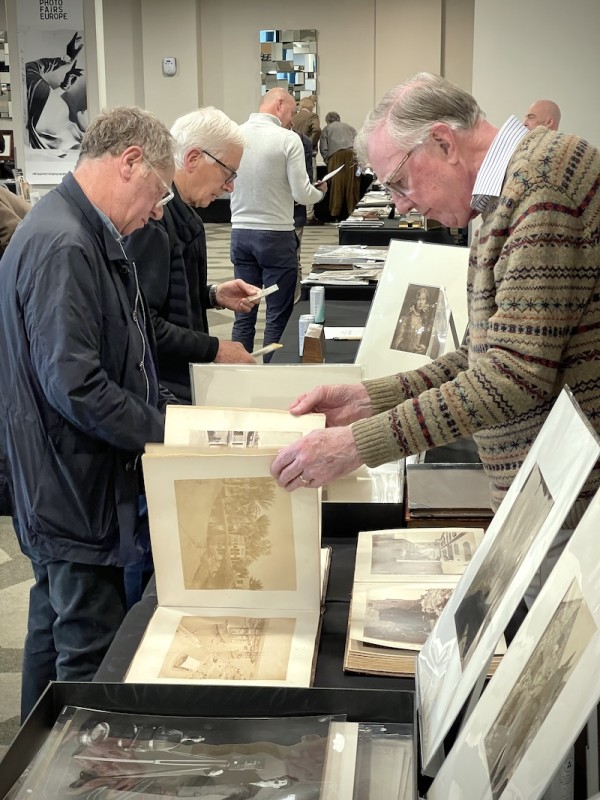
Michael Hoppen at Richard Meara’s table. (Photo Courtesy of Stefan Fielder)
In March this year, Austin Farahar, Head of Photographica at Chiswick Auctions, London, announced that he was going ahead with an idea he had had for some time, a tabletop fair to be held during Photo London on Saturday, May 16th. The result was The Other Photography Fair, held at Hilton London Olympia, a short walk from the main fair. Farahar achieved wonders considering the time frame.
The venue was great, there were dealers from Europe, as well as the UK, including: Richard Meara, James Kerr, Roland Belgrave, James Hyman, Linus Carr, Daniel Newburg Robert Hershkowitz Ltd, Paul Cordes, Vienna Vintage Photo Fair, Camden Photographs, Adnan Sezer, Bruno Tartarin, Olivier De Georges, Barnabé Moinard, plus demonstrations of tintypes, cyanotypes, photogravures and platinum prints by TinType Teddington, Constanza Isaza of Lux Darkroom and Peter Moseley.
The formula of having a tabletop fair during a major photography fair has worked extremely well in Paris, with the 24.39 Classic Photography Fair piggybacking on Paris Photo. But that's Paris and this was London. And Photo London doesn't get the same number of curators and vintage collectors as Paris Photo does. There were also storm clouds over London that day, in the form of two major demonstrations, one to support the Palestinian cause and commemorate 78 years since the Nakba, the other, a Unite the Kingdom, organized by the notorious right-wing figure Tommy Robinson. Many feared an open battle in London. Effective policing stopped this, but many Londoners decided to stay put. Still, I spotted many well-known players, including Michael Hoppen, Ken Jacobson, Timothy Prus, Michael Pritchard, David Thompson, Richard Fattorini, Lindsey Stewart and Marta Weiss at the Other Photography Fair.
Richard Meara was promoter of the long-running but now-defunct London Photograph Fair, though a remnant continues as Bloomsbury Photograph Fair under the umbrella of the Bloomsbury Book Fair.
He told me, "I think the fair went really well, and Austin is to be congratulated. The venue was excellent, which makes a huge difference, and it was all laid out well. The location made sense vis a vis Photo London, but I am not sure how much crossover traffic there was. The morning was busy, but it was much quieter in the afternoon. I tended to sell lower value items; people were resistant to spending big, although I sold higher ticket pieces to other dealers. I sold a pair of rare prints of the construction of the Great Eastern, possibly by Howlett, and a print of Mecca. I did not sell the nice, but more expensive albums of India and the Holy Land that I had brought. My box of vernacular prints at £5 and £10 each was very popular. Overall, I took more than I had mentally penciled in beforehand so I was happy. I hope Austin runs it again next year."
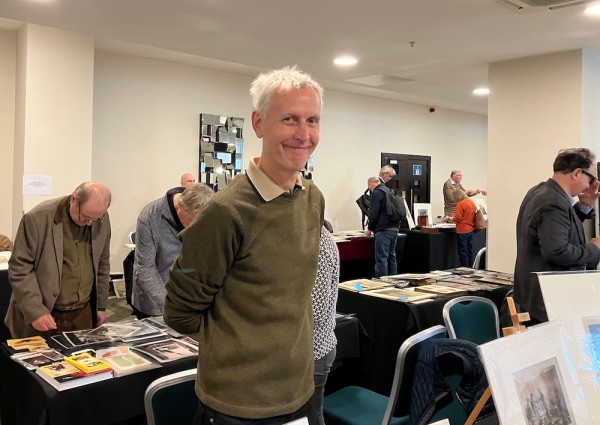
Paul Cordes. (Photo Courtesy of Michael Diemar)
Paul Cordes of Classic Photographics was also positive about the experience. "Austin and his team produced a very good fair, in a very short space of time. The fair venue was all we could ask for as dealers. It was spacious, airy and with great light. The location was good, close to Photo London and the book fairs. We need to get the visitor numbers up, and this will hopefully happen for future events if we all advertise to our communities.
Cordes had brought some interesting material. "I concentrated on a collection of Whitby images by Frank Meadow Sutcliffe that I acquired in nearby Robin Hoods Bay from a collector of 30 years. His house required a new roof, and he figured it was time to sell. Most were carbon prints, with a number of them in original oak frames made by Sutcliffe. I also brought a group of images showing sailors and fisherfolk in Scarborough by an unknown photographer. Sales were relatively good, with three works by Sutcliffe and a number of the Scarborough images sold. It was very encouraging that I made sales to new collectors, and two were to first-time buyers, asking questions about the work and photographers."
Also exhibiting was Stefan Fiedler, one of the promoters behind the Vienna Vintage Photo Fair which held its inaugural edition in 2023.
Fiedler said, "I think the fair was a very promising start of what everyone hopes will become a fixed date in the international vintage photo fair calendar. I am convinced that England and London deserve such an event, hopefully with more continuity than comparable fairs during recent years. I liked the location with regards to atmosphere and layout of the room in relation to the number of dealers. I am not sure though if the proximity to the new Photo London venue at the Olympia, which I like better than Somerset House, pays off. In case there is no synergy, then there might be better locations."
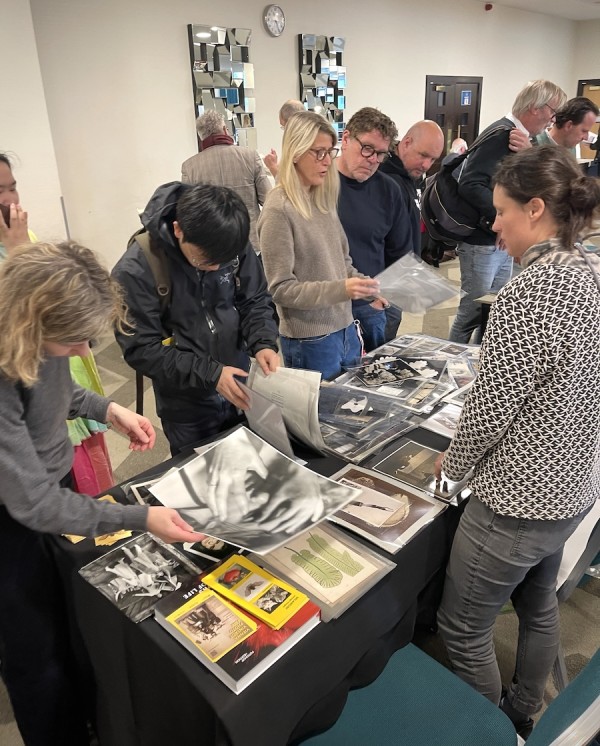
Mila Palm, Vienna Vintage Photo Fair. (Photo Courtesy of Stefan Fielder)
Fiedler continued: "There were not quite as many visitors as I hoped, or as we are used to at the Vienna Vintage Photo Fair. We especially missed younger visitors; art students, artists, the lifestyle and retro crowds etc.). The quality of the material offered was good, but there were not many vernacular photographs and snapshots that would attract younger people. With more time for preparation and feedback from the first event, I am sure that Austin will manage to get more visitors to future fairs. I mainly brought some smaller pieces (daguerreotypes, ambrotypes, rare double-sided CDVs and cabinet cards etc.) due to size and weight limitations when traveling. I sold a daguerreotype and a rare Stirn concealed vest camera, a type of espionage camera, and an album with small, round photos. Other than that, I had many interesting conversations with colleagues, collectors, curators and general visitors. It was interesting to see that the Photographica Fair on Sunday, mostly cameras, but also some nice photographs and ephemera, attracted by far more visitors than The Other Photography Fair the day before. In Vienna, it is the other way round: our vintage photo fair has a lot more visitors than the traditional historic camera fairs, held twice a year. Why is that I wonder? Still, all in all, the combination of Photo London, The Other Photography Fair, the Photographica Fair and some museum and pub visits, made it another great trip to London!"
There was some crossover traffic. I met a number of collectors at Photo London whom I hadn't met before and told them about the fair. Several showed up, including a new collector from the Philippines, who bought from Camden Photographs, who had brought contact sheets by Horst, Penn and Steven Meisel.
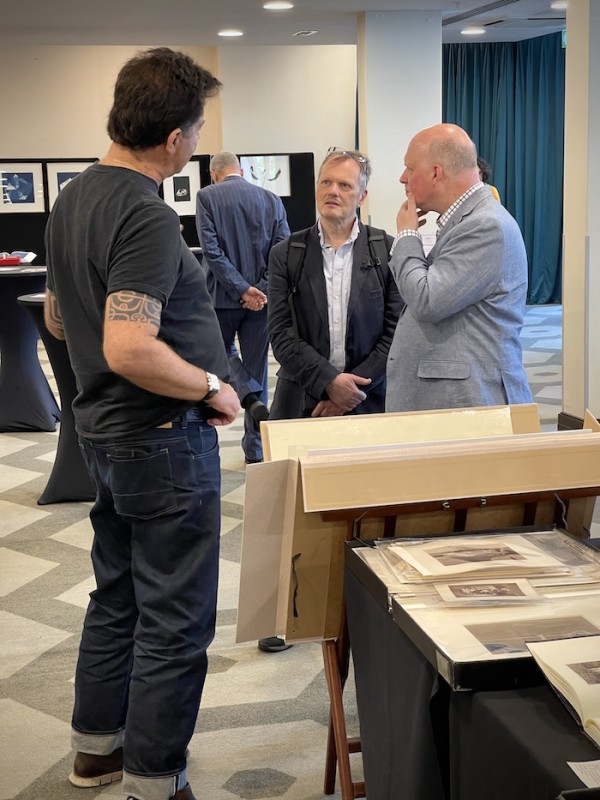
Roland Belgrave, Michael Pritchard and Richard Fattorini. (Photo Courtesy of Stefan Fielder)
Next to them, at the end of room, was Daniella Dangoor. She told us, "The fair was beautifully organized and the venue was great. With more time to publicize next year's edition, it should be great. Sales were so-so. I sold two great photographs, a daguerreotype and a beautiful Beato to colleagues."
One of her customers was Roland Belgrave, who said, "I thought the fair was a really great initiative. The venue was wonderful and there was a great turnout of dealers. For me, it was great opportunity to buy, and I acquired some very nice things, including a photograph by Beato that I bought from Daniella but I didn't sell much. My daughter was in charge of my table for the rest of the afternoon as I was exhibiting not only at Photo London, but also at the London Rare & Antiquarian Book Fair, and that was where I did really well. I sold photographs of Central Asia and an important John Thompson book."
Exhibiting close by was James Kerr. Kerr said, "I thought it was a great event. The market won't sustain more than one dedicated tabletop fair for vintage photography, but I think it is critically important that we do have one event in Photo London/book fair week. That Austin was willing to take the plunge was to be commended. He did a good job. The event was well publicized, particularly on social media, and it was gratifying to see a steady stream of visitors for much of the day. These things do not succeed overnight, but he has laid a really solid foundation, and I do hope he will do it again next year. The Vintage Photo Fairs Europe initiative is doing good work in flying the flag for the sector, and it is important that London has a place in their calendar."
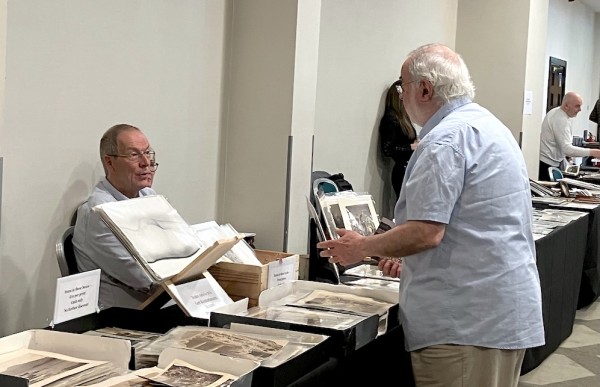
Ken Jacobson at James Kerr’s table. (Photo Courtesy of Michael Diemar)
Regarding sales, Kerr told me, "I've struggled to find interesting new material of late, but I brought a good selection of 19th-century travel images, some Coburn photogravures of London and New York, and a couple of boxes of well-priced material that I hoped might encourage fledging collectors and those with an eye for a bargain! Overall, I was pleased. We sold across the range and did better than expected. The market is not easy at the moment, and I don't think that is exclusive to 19th-century photography, so I did not come with huge expectations, but trade was solid."
Others, including Linus Carr and Robert Hershkowitz Ltd reported satisfactory sales.
After the fair, I interviewed the fair’s organizer, Austin Farahar.
Just how did the show all come together?
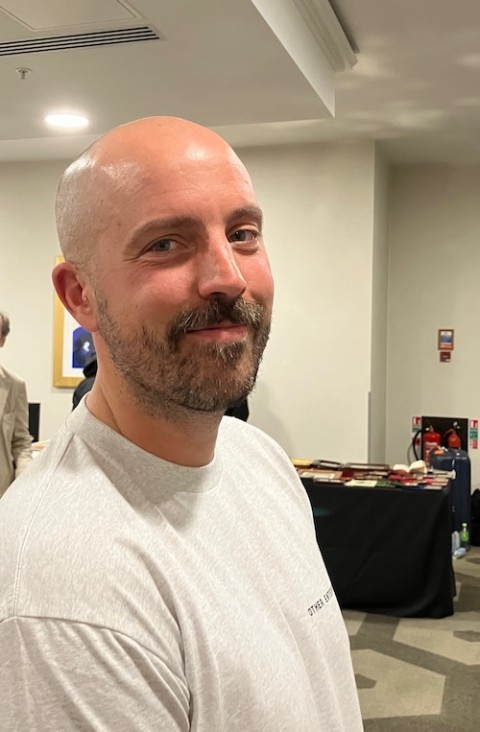
The fair's organizer Austin Farahar. (Photo Courtesy of Michael Diemar)
"I searched around the area for spaces before committing to putting the event on. Having helped Daniella Dangoor on the Classic Photo Fair a few years back, I had an idea of what to expect. My prime objective was trying to fulfill the criteria, from a dealer's perspective, of what was required for this type of fair, while keeping it as affordable as possible for the exhibitors to take part. It was important for me to make it difficult for the dealers on the fair circuit to say “no” as it was an untested event. I wanted to attract all those familiar faces from years gone by, but also those we haven't seen enough of since Brexit. There were a few promising places I found during initial research trips, but nothing felt quite right, until I managed to find the space in the Hilton. The space was light, the location was perfect, and I could make the maths work, but only just! At that point I committed to the venue and put a deposit down. There's nothing like a bit of pressure to build an event quickly. Doing it outside of my normal working schedule as an auctioneer meant calling in a lot of favors from friends and family, but I am very fortunate to have a talented network of people around me, both professionally and personally, and they all went above and beyond in terms of what I thought would be possible in such a short time."
You also added demonstrations of various processes.
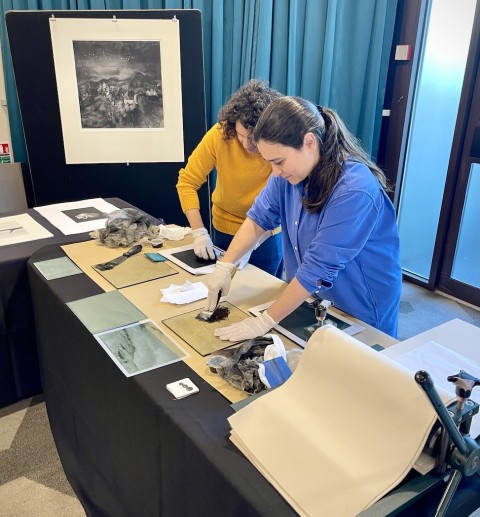
Demonstration of photogravures by Constanza Isaza of Lux Darkroom. (Photo Courtesy of Stefan Fielder)
"It has always been very important for me to try and make the market as accessible as possible for newcomers. I have been trying to do this at Chiswick Auctions for nearly a decade now. In my opinion, educating people about the processes creates an informed and grounded understanding and appreciation of photography, particularly when dealing with vintage material. To understand the value, we must become better informed both in a historical but also a technical context. The wet collodion, salt paper, platinum and cyanotype practitioners were all invited to provide something of a spectacle for visitors to engage with, but also with education in mind for those who would then set off around the exhibitor tables."
What did the exhibitors report back to you?
"Feedback was overall very positive. The dealers were all supportive and kind about the fair. They all seemed rather happy to all be in a room together reconnecting, trading and discussing Photographs. With so much of the industry online these days, even with auctions as well, I think people just like to see each other from time to time. I was very happy to see a few key gallerists, national curators and esteemed collectors in the room. Chiswick Auctions sponsorship of the event, including the scheduling of a few targeted marketing emails to our Photography mailing list, no doubt helped. I have been building that mailing list for a long time and through nearly 100 sales, so it was great to use it to promote something other than an auction."
The fair was held during Photo London. Did you feel that this helped attendance?
"I do think it helped attendance, but I think we could do much more given a longer planning period, hopefully with some cooperation from the Photo London organizers. What we offer is such a different selection of material, compared to what you will typically find in the Olympia Hall, and I think that the visitors who visited both really enjoyed the juxtaposition. What I love about photography is its breadth and ability to transcend so many different genres and interests. Both fairs being held at the same time opposite each other just reinforces this idea for me and creates more excitement around the art form."
Were there lessons to be learned for next year?
"Certainly! Many lessons. When the exhibitor feedback forms are returned, we will sit down, reassess and begin planning once again."
Michael Diemar is editor-in-chief of The Classic, a print and digital magazine about classic photography. In August 2025, he cofounded Vintage Photo Fairs Europe, an organization focused on promoting independent tabletop fairs in Europe and spreading knowledge about classic photography in general. He is a long-time writer about the photography scene, writing extensively for several Scandinavian photography publications, as well as for the E-Photo Newsletter and I Photo Central.


Share This