

MIA Photo Fair BNP Faribas: Milan’s Photo Fair Undergoes Metamorphosis
Interview: Ettore Molinario, Italian Collector with a Live-in Museum
Interview: Vladimír Birgus, Czech Photographer and Photohistorian
Noted 19th-century Photo Dealer and Expert Robert Hershkowitz Passes away
Make an Appointment with Us during AIPAD
Met Museum of Art Appoints Oluremi C. Onabanjo as Photography Curator
Book Review: PAPER PRINTERS PRINTING – Photographs from the Collection of Barry Singer
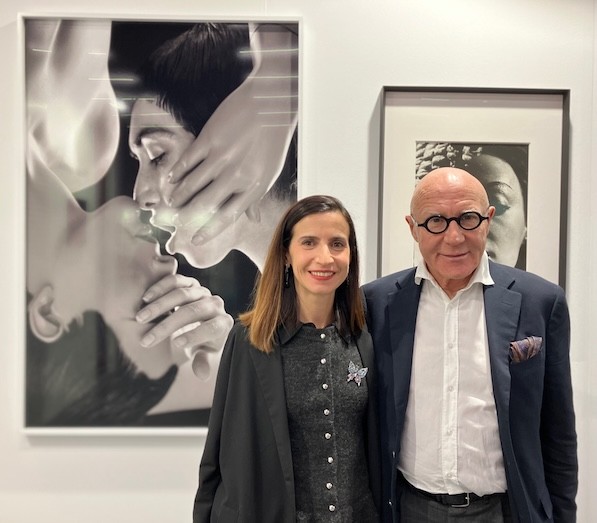
Chiara Panarello and Ettore Molinario at their stand at the Mia Photo Fair. (Photo by Michael Diemar)
Last year, the Italian collector Ettore Molinario and his wife Rossella Colombari opened the much-anticipated Casa Museo Molinario Colombari in Milan. It is a live-in museum, showcasing an impressive collection of photography, furniture and sculpture, for private tours, exhibitions and conferences. Molinario is well known in the international photography world as a collector of images of gender fluidity, but a visit to his website, https://www.collezionemolinario.com, makes clear that he collects other types of imagery as well.
The juxtapositions of two seemingly unrelated images can reveal deeper meanings, and so five years ago, Molinario launched Dialogues, a free newsletter, discussing such meetings. As he explains in the introduction: "The images in the collection date from 1850 to today and come from all over the world. The Dialogues retrace the themes most dear to the collector’s reflection; hence the search for oneself, gender identity, desire, and melancholy. Through these combinations, highlighted by the temporal anachronism and Warburgian montage, the collector reinterprets the images, bringing to light new meanings."
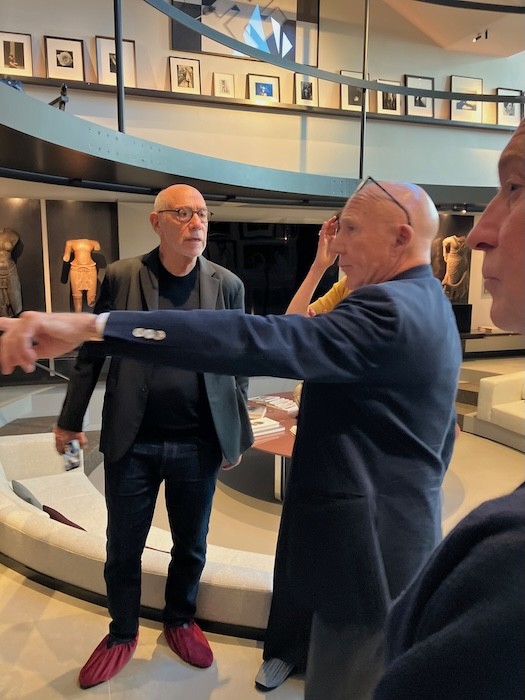
Howard Greenberg and Ettore Molinario at Casa Museo Molinari Colombari. (Photo by Michael Diemar)
A day before my interview with Molinario, I visited Casa Museo Molinario Colombari with other invited guests, including Howard Greenberg, James Hyman and Anette Kicken. The house is very impressive. I have met a lot of collectors over the years but none like Molinario. While the collection includes numerous works by the leading names, Man Ray, Edward Steichen, August Sander, Robert Mapplethorpe, Joel-Peter Witkin and André Kertész, the works have been chosen for very specific reasons. The works he acquires have to resonate very deeply with his personal concerns, and as he guided our group around Casa Museo, talking about the works, photographs as well as Khmer, Gandhara and early Medieval Indian sculpture, he did so with a remarkable intensity.
We were also shown a 12-minute film, Lezioni d’Abisso (Lessons from the Abyss). Shot at the house, highly stylized and directed by Tommaso Ottomano, it explores, as Molinario puts it, "the Freudian concept of the uncanny as a space of attraction and mystery, where what frightens us becomes unexpectedly familiar. The house is not merely a physical space, but a metaphor for the unconscious: a time capsule preserving inner chaos, dreams and nightmares, and our most secret impulses. Through evocative imagery, the film portrays this inner universe as if it were contained within the female body and figure, conceived as both origin and vessel of all emotions, luminous and dark alike."
In the second act of the film, Molinario and Rossella Colombari appear, disguised and with their gender roles reversed. He, in makeup and stilettos, she in a suit and painted on mustache, confronting each other at the dining table in a symbolic duel. "Each bite unleashes a vortex of powerful, violent, sensual, and poetic imagery drawn from the collection: art becomes total nourishment, capable of feeding mind, heart, and desire itself," as Molinario puts it.
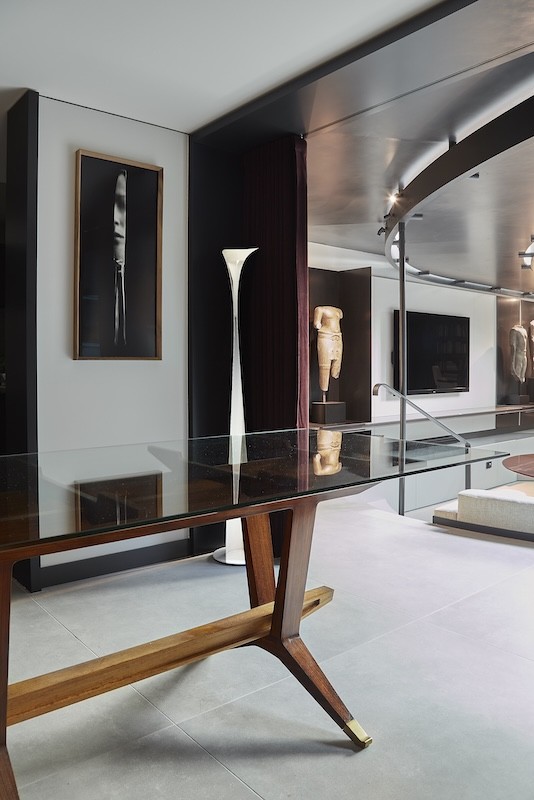
On the wall, L'âme du couteau by Alain Fleischer, gelatin silver print, France, 1982. Dining table designed by Melchiorre Bega, Italy, circa 1950. (Photo courtesy of Casa Museo Molinario Colombari)
He also appears in full diving gear, declaring another of his passions. "I became a marine speleologist, an explorer of caves, to make my research into myself go even deeper. When I descend to a depth of almost one hundred meters below the earth’s surface, I live at the very limits of my physical and mental balance, and I experience the riskiest and potentially deadliest descent within myself. But in the face of my impulses, being underground and immersed in the darkness of the water, I learned to remain calm and rational and have everything under control. And for me, control is a strong theme. Indeed, I could say that my collection is a way for me to control and dominate my imagination."
I started my conversation with Molinario by asking when and how he became a collector of photography.
"After my university studies, I started working in finance and spent several years in London and New York before returning to Italy. When I was nearly 50, I left the world of finance to start "a second life". I was very taken with photography and started acquiring photographs and wanted to go deeper into the medium. My wife Rossella told me that I needed to study, and that I couldn’t be a serious collector without proper knowledge. I took her advice and at the age of 50, I took a degree in History of Art. It was a really great experience to immerse myself in the subject and I also enjoyed being surrounded by young people."
What did you do after that?
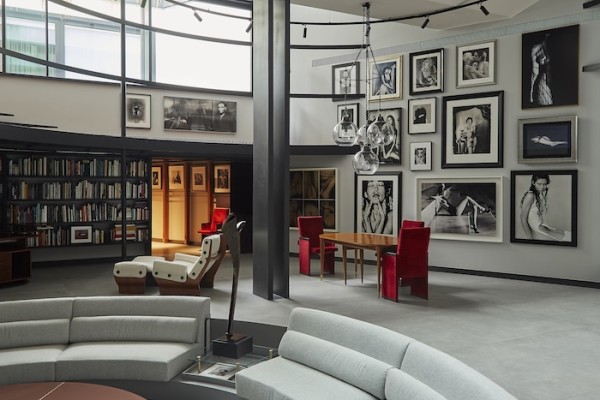
Living room. On the walls; photographs by Paolo Gioli, Urs Lüti, Joel-Peter Witkin, Bettina Rheims, Bill Brandt, Herb Ritts, Henry Callahan and others. White armchair with ottoman model P110-Canada, designed by Osvaldo Borsani, Italy 1969. Red chairs designed by Carlo Scarpa, Italy circa 1950. Dining table designed by Gio Ponti, USA, circa 1950. Ceiling lamp designed by Luigi Caccia Dominioni, Italy 1967. Prestige Club, Fiji Islands, circa 1820. (Photo courtesy of Casa Museo Molinario Colombari)
"With my degree in bachelor of art, I decided to go on a kind of grand tour to the most important museums in the world. For the next four years, I travelled to 240 museums around the world. I was traveling alone, taking my time and I looked not only at photography but also at paintings, design, architecture, theater, music–whatever I could to broaden my knowledge of the world of art. It also deepened my knowledge of what I personally liked and what I responded to. I kept collecting, and my collection became more and more a sort of introspection, an exploration of my identity, whether it was the full image or part of an image."
Can you tell me what kinds of images they were?
"I started to analyze the images that triggered me, and I found that they related to four or five pillars of my identity. There was the relation between life and death. There was androgyny. The relation between the male and female parts of ourselves, fetishism, the melancholy and the uncanny. This intensified my collecting because the images helped me accept different parts of myself, and so collecting and looking at photographs became a sort of psychoanalysis. A mirror of sorts, one that I could look at and reflect upon. I ended up buying obsessively. One photograph after another."
As I understand it, you were focused mainly on contemporary works during that period.
"That’s correct but then I realized that I was buying images of more or less the same themes and felt that I wanted to expand the concept of the collection. I had the luck to meet a curator, Laura Leonelli, and with her help, I went further back in the history of photography. I found that there were incredible images on the same themes that I had collected but created 50 or 100 years before, and that, in so many cases with the great contemporary artists, there had been pioneers before them. It made me look differently on the history of photography and culture as a whole. It made my exploration of photography very exciting. It also completed the timeline of the development of my own identity. I could trace it from the beginning of the history of photography."
You also added photographs by unknown makers to the collection.
.jpg "Pierre-Louis Pierson, Scherzo di Follia (The Countess of Castiglione), circa 1863, France. Gelatin silver print, enlargement printed circa 1930 by Braun & Cie. (Photo courtesy of Casa Museo Molinario Colombari)")
Pierre-Louis Pierson, Scherzo di Follia (The Countess of Castiglione), circa 1863, France. Gelatin silver print, enlargement printed circa 1930 by Braun & Cie. (Photo courtesy of Casa Museo Molinario Colombari)
"That was a big challenge but the rewards were fantastic, because it was about having the capability to detect strong images with no names or galleries behind them. I think that’s the highest point that a collector can reach. This also meant that the collection began to include photographers from different cultures from all over the world. Again, reflecting aspects of my own identity, the same topics, but with different esthetics. It was very interesting, seeing the differences, the different styles and approaches to the same subjects. It was very important for me as a collector to focus on the strength of the image and its capacity to transmit something deep, no matter what value the market place put on that work. That is the point a true collector should reach. Having said that, it takes a lot of effort because today we are bombarded with images from all directions, so you have to be very focused to acquire those images."
What makes your collection special is the intensity of the relationship you have with the images.
"The intensity comes from the identification and that is not something that you can build. It has to come naturally. Sometimes, however, I don’t know why I am attracted to a certain image and that’s when it gets especially interesting. I see it, I need to possess it and I buy, and eventually, having looked at it for a considerable amount of time, I realize something about myself that I didn’t know but drew me to it. This has happened frequently over the years. On the other hand, there are images I come across and I immediately connect with and see myself in them. As if there were vibrations going from the collector to the image, and from the image to the collector. That is why the collection is so important to me: because the collection evolves, and it does so within my own evolution. It also means that the works I buy now are not the kinds of works I will buy in 10 years’ time, or what I bought at the beginning. The identification is different. That’s the beauty, because it’s a never-ending story."
You also collect Gandhara, Khmer and early Medieval Indian sculpture. Is there a dialog between them and the photography collection?
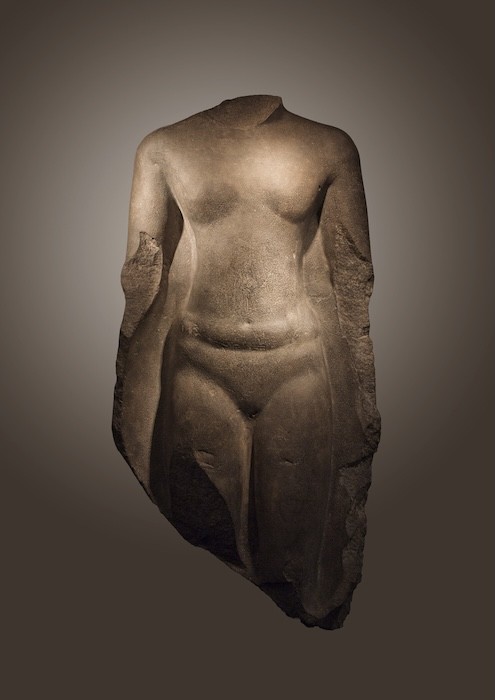
Torso of Buddha, Dvaravati, 7th century, Cambodia or Thailand. (Photo courtesy of Casa Museo Molinario Colombari)
"Yes, there is. I started collecting sculpture some 15 years after I started collecting photography. I was very taken by these artworks and I became friendly with an important and very capable dealer and gallerist who was focused on Indian and Southeast Asia works. There was another reason why I was attracted to these works. Twenty-five years ago, I became a Buddhist and I was in the process of accepting and loving Buddhist philosophy. The works from this period and this geographic area really spoke to me. That was another kind of identification. In this case, the identification was not only based on the forms but also related to the philosophy of life. Another reason was that, unlike Greek and Roman sculpture, the forms were very abstract and androgynous, and therefore linked to one aspect of the collection of photographs. But with these works, it was presented in three dimensions. And because these works are headless, it means you can’t immediately tell if they are male or female."
Last year, you and your wife opened Casa Museo, a live-in museum. Can you tell me about the project and when the idea emerged and how it progressed?
"When I took my Grand Tour after my history of art studies, I spent a lot of time in Paris, of course, and fell in love with the private houses of important collectors that had been turned into museums. I was very taken with the idea of living within a collection and how they would share their passions with friends and acquaintances. Then, of course, those collectors passed away, their homes became museums, open to the general public. At a certain point of building my own collection, I began to think about its future. I was putting a lot of energy into the process of acquisition. I realized I had two options: either to stop collecting and sell whatever I had collected or to ensure a future for it. It is a very important topic, especially in Italy, where we have many, many collectors. I have many friends who are collectors and they don’t think about this at all. Will their children take care of their collections? Or sell them? The idea of my own collection being sold and split was completely unacceptable to me. As I said, I was much taken with those houses I had seen in Paris, but time had stopped there. There was no life in them. I began dreaming of a museum but one that was lived in, and I discussed it with my wife Rossella."
How did you go about turning it into reality?
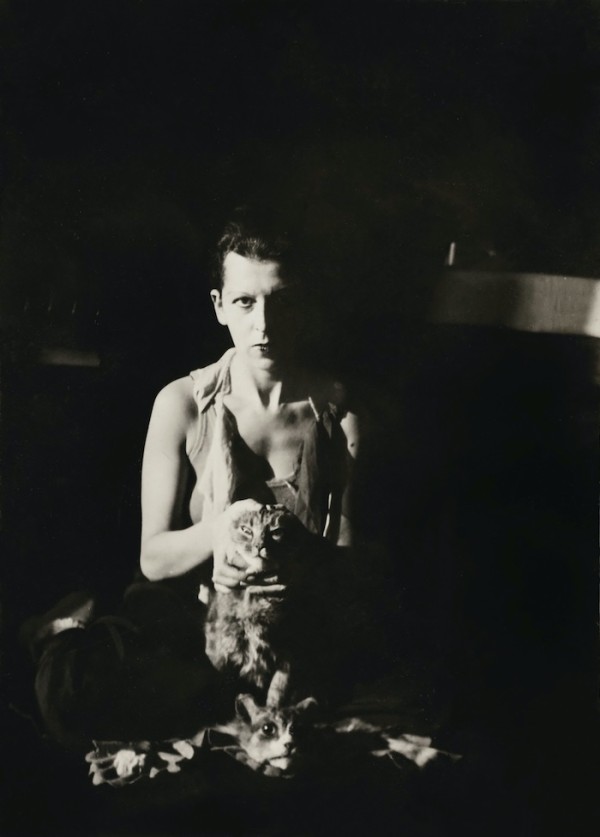
Claude Cahun. Autoportrait au chat, gelatin silver print, France, 1927. (Photo courtesy of Casa Museo Molinario Colombari)
"I said, ‘Okay, if I have a dream, I want to try to turn it into reality. I started looking for a space to house the collection and to live in. I was lucky to find an early 20th-century silversmith factory in the Isola district of Milan. Today, Isola is one of the most vital epicenters of the city. I entrusted the project to architects Claudio Lazzarini, Carl Pickering and Marco Lavit. Together with them, the idea of a large circular, dynamic, open and very bright environment was born. My wife was more fluid about this concept. She’s not really a collector. She is a dealer in important 20th-century furniture, used to buying and selling, even if an object is great and she loves it. If I have an important piece that I bought, I want to keep it, and I have never sold a single piece of my collection. The idea was to have a space in the center of Milan, in order to be close to the art community. And I wanted people to come here and meet me so I could show them around. There are other Casa Museo in Milan but while they are beautiful, no one lives there so there’s no human energy. Here, the collector lives in the space, which means I can promote the arts; photography, cultures, architecture, whatever. Of course, we cannot have a daily flow of people because we live there. Instead, we decided to open our doors one afternoon every week and conduct guided tours. I also think it’s very important that the people who come there get to meet the collector who can explain how the collection came into being."
Before you opened the museum, you were already becoming known out there through the dialogs. It’s evidently important for you to share the collection.
"The dialogs have been our main vehicles of communication over the last five years. The idea came up in conversation with Laura Leonell, choosing pictures that apparently had nothing in common, digging into the DNA of each picture, and finding the story behind the esthetic. Our dialogs became a sort of third dimension. The project was very interesting, the dialogs were sent out by free subscription and we got a lot of followers. The dialogs were very close to the approach of the collection itself, where there are numerous intersections where different works meet. In an almost Warburgian way, that is, related to the interdisciplinary approach of German art historian Aby Warburg. All in all, we produced 50 dialogs and then we decided to stop and come up with something new. And the short film we made is part of the process of moving things along."
Do you have other strategies? Such as putting on exhibitions with outside partners, for instance?
"I decided to move in two different directions: the future of the collection and the works to be acquired, and on the other end, the evolution of the project of the Casa Museo. These two directions are linked because they are two faces of the same medal but they have different goals. I want to make the collection known internationally so we are looking to collaborate on exhibitions with museums in other countries, that is, create dialogs between our collection and theirs and in so doing, creating something new. I needed to have a person to run this project, which is long-term, and was lucky to be joined by Chiara Panarello who is now the director of the collection. She has the ability and the experience to move this forward. With the Casa Museo, we want to create a cultural hub where we can promote cultural events and create a dialog between architecture, culture, photography and design. Make it visible in Italy and attract people from overseas who come to Milan because the city is very fertile, so we will have different events throughout the year. Invite people with a different vision to visit the Casa Museo and bring their own ideas."
You have just made the film Lezioni d"Abisso (Lessons from the Abyss). What part does it play in your scheme of things?
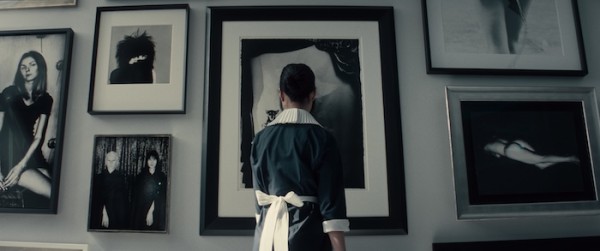
Still from the film Lezioni d’Abisso (Lessons from the Abyss), directed by Tommaso Ottomano. (Photo courtesy of Casa Museo Molinario Colombari)
"The film came about because we wanted to have something cinematographic to represent the collection. I believe the collector creates his own work of art with a collection. Now, the ultimate step for a collector is to interpret his collection so you can consider the movie as a part of the collection. It is the latest project for the collection that could anticipate future acquisitions, of video art and anticipate artificial intelligence works or something else. The movie is very much in line with the vision and the mission of Casa Museo and there is complete transparency between the viewer and the collectors, what they are doing and the viewer. It is the point where we take off our veils and present ourselves. It’s something real."
You mentioned video art and artificial intelligence. Is it important for you to enter new territories, almost in order to test yourself?
"This is a very interesting question for me because, up to a year ago, I was completely focused on moving backwards in order to reinforce the historical part of the collection. I enjoyed it a lot because also I really learned a lot about photography, but at a certain point, I understood that I had reached a point where I really needed to move forward, into the contemporary world. That’s why I decided to take a new director for the collection to take me there. I probably couldn’t do it on my own, because I have the vision of a 68-year-old person and I need somebody to take me out of my comfort zone. And when you move outside of your comfort zone, you never know where you’re going to end up. But this is giving me a lot of energy, and right now, I just want to move forward. In a sense, making the movie made me aware that I was distancing myself from the past, moving into the future. I am very receptive to the proposal that Chiara Panarello is forcing me to take because maybe I don’t see many links with the past, but I need to trust somebody to take me out of the comfort zone. But it’s not easy. I have built my collection based on a certain approach. All of a sudden, I have to evaluate other kinds of images, other kinds of topics, that always link with the collection, but with looser links so it’s a jump into the dark."
This process has already started. What have you acquired recently?
"I think collecting young artists is difficult. Because these days there is a sort of No Limits situation where anybody can display their works and immediately be accepted as an artist. But this is not always true art, which is something more profound. There is so much art being produced that selection is becoming more and more difficult. There is an overload of images. That’s why the assistance of Chiara Panarello is so important. I can share ideas, discuss works, get a different perspective but in the end, I have to go with my instincts. We are exhibiting a recent acquisition at the MIA Fair, a work by Clovis Bataille, an artist we discovered at Galleria Radar here in Milan. He works with photography but also with installation, sculpture, and works on paper. He took a whole series of photographs of abandoned objects, or found objects, in the streets of Paris. One was of an abandoned coat. I was deeply attracted to this photograph. It links to an identity, but to a hidden identity, somebody who’s no longer present so it really fits well within the themes of the collection. He’s an artist that we didn’t know before. He’s in his 20s, so we’re happy to support this. We have also highlighted two works by Mexican artist Teresa Margolles, that I acquired from the Parisian gallery Mor Charpentier at Paris Photo. Chiara brought me there. I was totally taken with the work but it doesn’t have much relation to what I have collected previously, so it stretches me, and I have to manage this conflict inside of me."
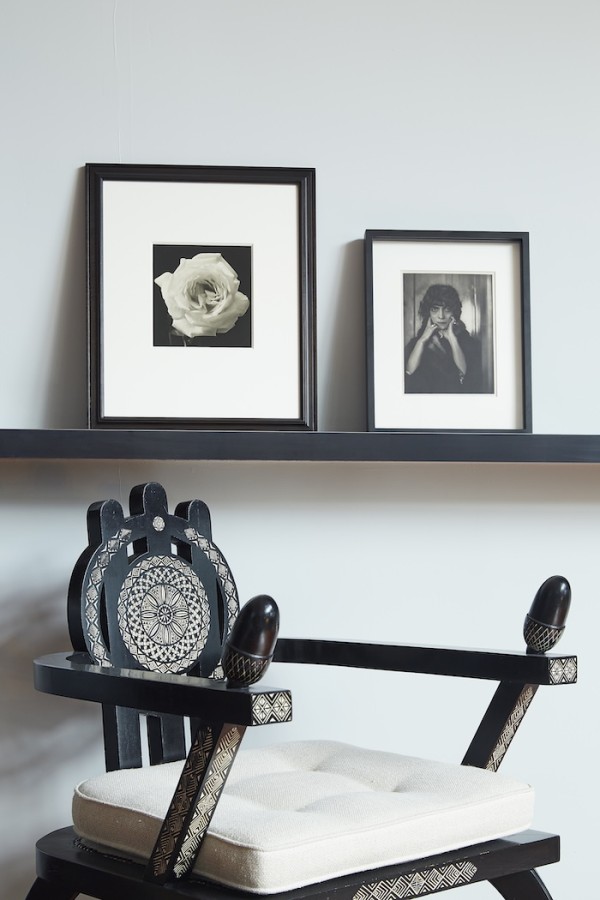
First floor, armchair designed by Ettore Zaccari, Italy, circa 1910. On the shelf, Untitled (Rose) by Edward Steichen, gelatin silver print, USA, circa 1920. Marchesa Casati by Baron Adolf De Meyer, gelatin silver print Paris, 1912. (Photo courtesy of Casa Museo Molinario Colombari)
You are continuing collecting with the same intensity but in different, and for you, new areas.
"Yes, and the work of Agnès Geoffray is another example. She is a French artist we discovered at the photography festival in Arles last summer. She had done a project where she had recreated the situation of young women in the 19th century and the early 20th century who were confined to psychiatric hospitals because of their sexual orientation. The expression of their sexuality being repressed. This series is really powerful. Another acquisition that was totally out of my comfort zone was the acquisition of the self-portrait of Hiroshi Sugimoto. I was at Paris Photo with my wife, and we saw this fantastic image. It was great but I couldn’t really see the link to my collection. Anyway, we bought it. Then, after a while, I realized why I was so taken with this image, because in my mind, I was looking at the image as an illustration of my own situation at this stage in my life and my identity at this moment. Sugimoto is dressed almost like a monk. He is wearing glasses but you can’t see his eyes, just the reflected light in the glass. It’s as if he is looking into the future. And who knows what the future will bring? For him? For me? I feel he’s saying something to me. Because all the images I buy are very linked with my own story. Many will regard the images in my collection as hard, so hard that they punch you in the stomach, but they are never vulgar. I believe they are all extremely elegant and that there’s always a strong esthetic there. That is my firm belief."
Michael Diemar is editor-in-chief of The Classic, a print and digital magazine about classic photography. In August 2025, he cofounded Vintage Photo Fairs Europe, an organization focused on promoting independent tabletop fairs in Europe and spreading knowledge about classic photography in general. He is a long-time writer about the photography scene, writing extensively for several Scandinavian photography publications, as well as for the E-Photo Newsletter and I Photo Central.
MIA Photo Fair BNP Faribas: Milan’s Photo Fair Undergoes Metamorphosis
Interview: Ettore Molinario, Italian Collector with a Live-in Museum
Interview: Vladimír Birgus, Czech Photographer and Photohistorian
Noted 19th-century Photo Dealer and Expert Robert Hershkowitz Passes away
Make an Appointment with Us during AIPAD
Met Museum of Art Appoints Oluremi C. Onabanjo as Photography Curator
Book Review: PAPER PRINTERS PRINTING – Photographs from the Collection of Barry Singer


Share This